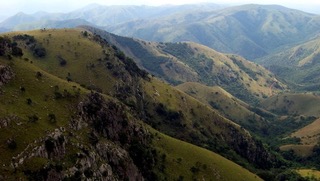
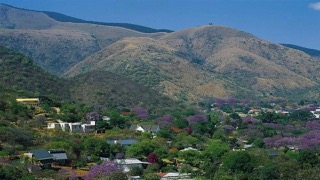
The Barberton Greenstone Belt lies in the Mpumalanga Province of South Africa close to
the border with Eswatini (formerly Swaziland). It constitutes one of the oldest and best
preserved pieces of the Earth’s crust dating to c.3.2 – 3.6 billion years and so sits within
the Archean Eon. As such, it provides an extraordinary record of what the Earth was like
when the planet was very young, oceans were forming and landmasses were just
beginning to emerge. A designated UNESCO World Heritage Site, it provides valuable
insights into the formation of the Earth’s early crust. As with all Greenstone Belts, it is
markedly linear in form and comprises a sequence of volcanic and sedimentary rocks
that have undergone multiple phases of deformation. What makes the Barberton
Greenstone Belt unique however, is the near pristine preservation of primary volcanic
and sedimentary structures within the rocks themselves. The BGS has and continues to
be a significant site for scientific research as it contains well-preserved evidence of
early life and tectonic activity, making it an important area for the study and
understanding of the planet’s formative processes.
Max Marchini was first introduced to geology as part of his education at Foyle College, Derry. He then went to QUB in from where he graduated in 1986 with a BSc and PhD in geology. From there, he emigrated to South Africa where he worked for seven years as an Exploration Geologist for Anglovaal Ltd exploring for primary gold and nickel deposits. During that time, he spent four years working in the Barberton Mountainland which has since been designated a UNESCO World Heritage Site for its unrivalled geological heritage.
- Speaker: Dr Max Marchini
- Monday 27th April 2026 7.00pm
- Venue: MCB